

Student or Disciple?
There is a Difference

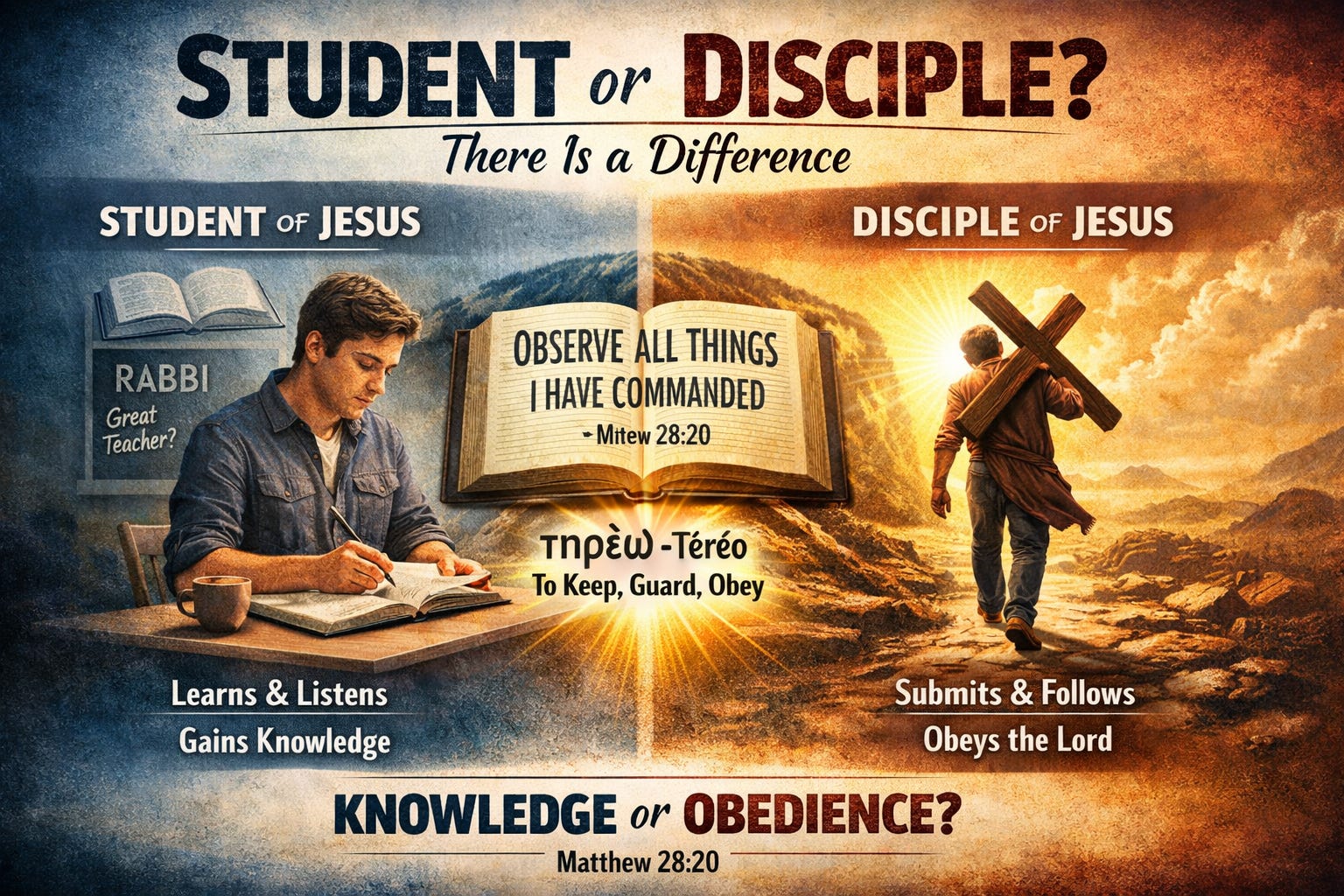
In a recent BibleQuest recording, a much respected brother in Christ and friend, Carl Ballard, pointed out a powerful parallel that deserves careful consideration. It was one of those observations that is simple on the surface, yet deeply convicting when you truly think it through.
There is a difference between being a student of Jesus and being a disciple of Jesus.
Sadly, many today are content to remain students—gaining knowledge, listening, and learning—without ever making the full transition into discipleship, which requires submission, obedience, and a transformed life. But when we let Scripture speak, it becomes clear: Jesus did not call us to be mere students. He called us to be disciples.
The Great Commission: More Than Just Teaching
In Matthew 28:19–20, Jesus gives His final instructions:
“Go therefore and make disciples of all the nations, baptizing them in the name of the Father and of the Son and of the Holy Spirit, teaching them to observe all things that I have commanded you…”
Notice carefully—Jesus did not say merely teach them information. He said:
“teach them to observe all things”
The word “observe” (Greek: τηρέω – tēreō ) means:
to keep
to guard
to hold fast
to obey
This is the same word used by Jesus in John 14:15:
“If you love Me, keep (tēreō) My commandments.”
This is critical:
A disciple is not someone who simply learns Christ’s teachings—but someone who keeps, guards, and obeys them.
Judas vs. the Eleven: Teacher or Lord?
We see a powerful contrast in Matthew 26:20–25.
When Jesus reveals that one will betray Him:
The eleven disciples respond:
“Lord, is it I?”
But Judas says:
“Rabbi, is it I?” (Rabbi = Teacher)
This difference is not accidental.
The eleven recognized Jesus as Lord—one to be obeyed and followed.
Judas saw Him only as Rabbi—a teacher to learn from, but not truly submit to.
A student calls Jesus “Teacher.”
A disciple calls Him “Lord.”
Students Seek Knowledge — Disciples Seek Transformation
Many today approach Christianity as students:
They enjoy Bible studies
They accumulate knowledge
They can quote Scripture
But their lives remain unchanged.
A disciple is different.
Jesus said in Luke 6:46:
“But why do you call Me ‘Lord, Lord,’ and not do the things which I say?”
A disciple:
Applies the Word
Submits to Christ’s authority
Orders their life according to His will
Knowledge without obedience is not discipleship—it is self-deception (see James 1:22).
True Discipleship Requires Submission
Romans 12:1–2 lays this out clearly:
“Present your bodies a living sacrifice… holy, acceptable to God…
And do not be conformed to this world, but be transformed by the renewing of your mind…”
This is not casual learning—this is total surrender.
A disciple:
Presents their life to God
Rejects conformity to the world
Pursues transformation
Seeks to prove “what is that good and acceptable and perfect will of God”
This is submission. This is following.
Disciples Abide and Continue
Jesus defines a true disciple in John 8:31:
“If you abide in My word, you are My disciples indeed.”
Not those who visit His word.
Not those who study occasionally.
But those who abide—who live in it, continue in it, and are shaped by it.
The Cost of Discipleship
Jesus never hid the cost:
Luke 9:23:
“If anyone desires to come after Me, let him deny himself, and take up his cross daily, and follow Me.”
A student adds knowledge to their life.
A disciple lays their life down.
Conclusion: Which Are We?
The call of Christ is not to be informed—it is to be transformed.
A student listens but does not follow
A disciple hears and obeys
A student calls Him Teacher
A disciple calls Him Lord
A student gains knowledge
A disciple submits their life
The Great Commission is not fulfilled by producing Bible students.
It is fulfilled by making disciples—those who are taught to observe (tēreō), to keep, to obey all that Christ commanded.
So the question is not:
What have we learned?
But rather:
What are we obeying?